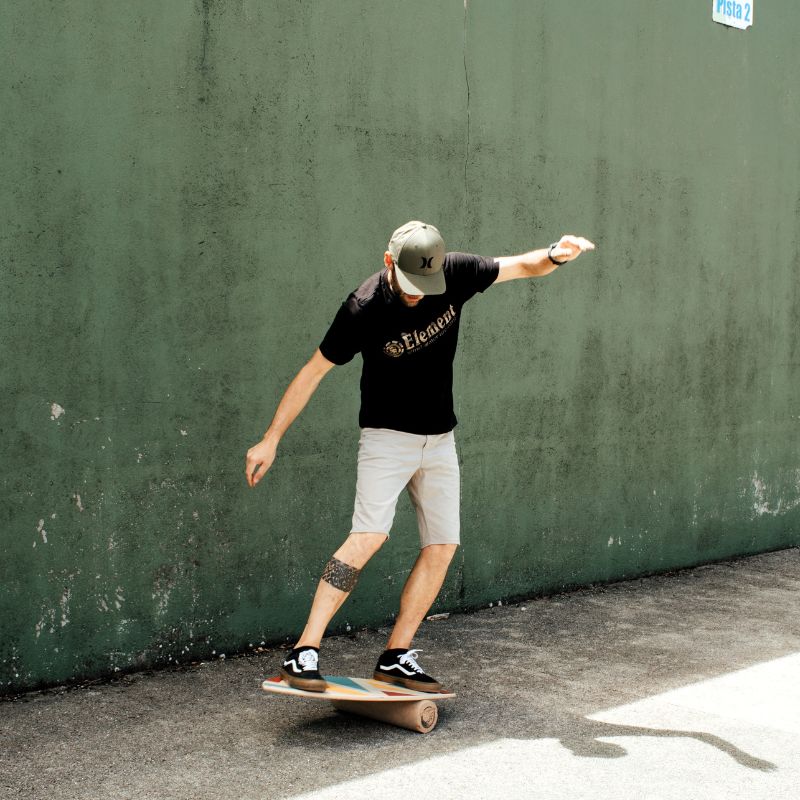

From World War II to your living room: the history of the balance board

Few objects have a history as unexpected as the balance board. What you see today in surfers' homes, gyms, and modern offices was born, quite literally, in the middle of a world war. And the path it took to get here says a lot about why this object has so much appeal.
1942: a pilot, a board, and an idea
It all started with Stanley Washburn Jr., an American World War II pilot. Washburn built a wooden board on top of a cylinder to train his balance and improve his coordination. He called it the Bongo Board. It wasn't a fitness product or a sports tool: it was a practical solution for a man who needed to stay fit between missions.
No one imagined then that this homemade contraption would end up in the hands of millions of people decades later.
The 70s: surfers discover it
The balance board could have been forgotten, but California surfers had a recurring problem: days without waves. They needed to keep training their balance, coordination, and board movements when the sea wasn't cooperating.
In 1975, Hunter Joslin, a California surfer and skater, developed his own version of the balance board and started using it as a personal trainer for board athletes. It wasn't a commercial product yet, but the idea that it really worked began to spread through the surfing community.
1998: the Indo Board changes everything
Joslin patented his creation in 1998 under the name Indo Board and launched it on the market. It was the first balance board product with its own identity, careful design, and the backing of professional athletes. Surfers, snowboarders, skaters, and high-performance coaches began to adopt it as a serious training tool.
From that moment on, the market began to grow. First in the United States, then in Europe and Australia, and gradually all over the world.
From the 2000s to today: from niche to culture
What started as a tool for board athletes expanded in every direction. Physiotherapists incorporated it into the rehabilitation of ankle and knee injuries. Neurologists discovered that balance training stimulated the connection between the brain hemispheres. Personal trainers added it to their functional fitness routines.
And then something unexpected happened: the balance board left the gym and entered the offices. The standing desk movement brought with it the idea of moving while working, and the balance board fit perfectly as an active complement for those who spend hours standing in front of a computer.
Today it is used by surfers, skaters, snowboarders, yogis, physiotherapists, remote workers, and young people, always respecting the minimum age indicated by each manufacturer. Wooden Surf models are recommended for those over 14 years old. It has stopped being a niche sports accessory to become an object with its own identity.

The freestyle scene: when balance becomes art
One of the most interesting phenomena of recent years is the growth of the balanceboarder community. A movement that goes beyond training and develops its own tricks, competitions, and teams. The rules are simple: three minutes on the board, the greatest number of tricks possible, the more complex the better.
It doesn't have Olympic recognition like skateboarding yet, but it follows exactly the same path that skate took decades ago: from a marginal activity to a discipline with a community, identity, and organized competition.
Why a handcrafted balance board is different
At Wooden Surf, we have been making balance boards by hand since 2019, with birch plywood and natural cork roller. Not because it is more expensive or more complicated, but because we believe that an object with this history deserves to be well made.

A balance board is not just another fitness accessory. It is a tool with decades of history, adopted by very different communities and with a potential that continues to grow. Making it carefully, with quality materials and with its own design is our way of respecting it.
If you don't have yours yet, now is a good time to start.