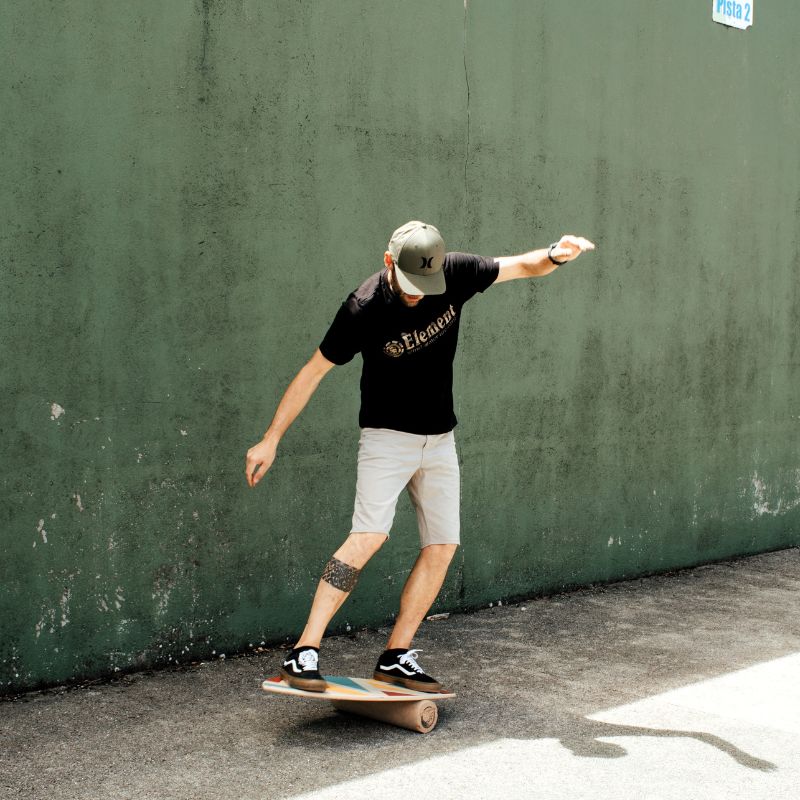

Exercises to improve balance and stability with Balance Boards
Exercises to Improve Balance and Stability with Balance Boards
Balance is a key skill in almost any sport and also in everyday life: walking on uneven terrain, climbing stairs, reacting to a trip… All of that depends on your stability.
Balance Boards are a very comprehensive tool for training that balance. With a single element you can work on strength, coordination, and core control, both in static positions and in more dynamic movements.
In this guide you will find a series of simple and progressive exercises to improve your balance and stability using a Balance Board, whether you are a beginner or already have experience.
For these exercises you only need a balance board, also called a balance board.
Exercise 1: Side Swaying
How to do it
-
Stand on the Balance Board with your feet shoulder-width apart.
-
Slightly bend your knees and engage your core.
-
Shift your weight from one side to the other slowly and in a controlled manner, without letting the edges of the board hit the floor abruptly.
-
Breathe calmly and keep your gaze forward, not on your feet.
Benefits
-
Improves lateral stability and body control.
-
Develops body awareness and coordination.
Variations
-
Do smaller and slower sways if you are just starting.
-
Increase the range of motion or try holding for a few seconds on each side to increase the difficulty.
-
When you master the exercise, try doing it with your arms crossed over your chest.
Exercise 2: Tree Pose on Balance Board
How to do it
-
Standing in the center of the Balance Board, distribute your weight evenly between both feet.
-
Lift one leg and place the sole of your foot on the inner thigh or calf of the other leg (avoid the knee).
-
Bring your hands together slightly in front of your chest or stretch them up.
-
Hold the pose for 15 to 30 seconds and switch legs.
Benefits
-
Improves static balance and concentration.
-
Strengthens the core, ankles, and stabilizing muscles of the legs.
Variations
-
If you struggle, place the tip of your foot on the floor, near the board, before lifting it completely.
-
Close your eyes for a few seconds to increase the challenge (only if you already feel safe).
-
Hold the pose for longer to also work on endurance.
Exercise 3: Rotating Plank
How to do it
-
Place the Balance Board on the floor and place your hands on the board, just below your shoulders.
-
Stretch your legs back until you are in a plank position, with your body in a straight line.
-
Turn your torso to one side, raising one arm toward the ceiling, and hold the position for one second.
-
Return to the center and repeat on the other side.
Benefits
-
Strengthens the core, shoulders, and hip stabilizing muscles.
-
Improves trunk stability and coordination in rotational movements.
Variations
-
Support your knees if you need an easier version.
-
For more intensity, add a push-up between turns.
-
Make the movement slower and more controlled to better activate the core.
Exercise 4: Calf Raises on Balance Board
How to do it
-
Stand on the Balance Board, with your feet hip-width apart.
-
Engage your core and keep your back straight.
-
Slowly raise your heels until you are on your tiptoes, hold the position for 2–3 seconds, and lower again.
-
Repeat 10 to 15 times.
Benefits
-
Strengthens the calves and the muscles around the ankle.
-
Improves stability on small points of contact, very useful for board sports.
Variations
-
Do the exercise with one foot for an extra challenge.
-
Hold up longer (5–8 seconds) to work on endurance.
-
Combine several quick repetitions with some slower and more controlled ones.
Exercise 5: Torso Rotations
How to do it
-
Stand on the Balance Board, with your feet shoulder-width apart and your knees slightly bent.
-
Bring your hands together in front of your chest or stretch your arms forward.
-
Turn your torso to one side without moving your hips excessively, return to the center, and turn to the other.
-
Maintain control of your balance throughout the movement.
Benefits
-
Improves spinal mobility and dynamic balance control.
-
Strengthens the core and helps transfer force better in turns and changes of direction.
Variations
-
Hold a light weight or a bottle of water to increase the difficulty.
-
Pause for one or two seconds in the turned position before returning to the center.
-
Slightly increase the speed of the turns when you feel safe.
Exercise 6: Push-ups on Balance Board
How to do it
-
Place the Balance Board on the floor and place your hands on the board, slightly wider than shoulder-width.
-
Stretch your legs back and engage your core.
-
Lower your chest toward the board while keeping your body in a straight line, and push back up in a controlled manner.
-
Perform 8 to 12 repetitions depending on your level.
Benefits
-
Strengthens the chest, shoulders, triceps, and core at the same time.
-
Improves wrist and shoulder stability by working on an unstable surface.
Variations
-
Support your knees for a more accessible version.
-
Lift one foot or alternate support to work the core more.
-
Add a shoulder tap (hand to the opposite shoulder) at the end of each push-up to increase the challenge.
Exercise 7: Squat with a Soft Jump
How to do it
-
Stand on the Balance Board with your feet hip-width apart.
-
Bend your knees and move your hips back, as if you were going to do a squat.
-
Perform a small jump, barely separating yourself from the board, and land softly returning to the squat position.
-
Make sure to regain your balance before repeating.
Benefits
-
Improves leg power and reaction capacity.
-
Trains stability when entering and exiting the board in quick movements.
Variations
-
Do short lateral jumps (from one side to the other of the board) to work on lateral stability.
-
If you are a beginner, start only with squats without jumping and add the jump later.
-
Limit the repetitions and rest well between sets so as not to compromise technique.
Safety Tips When Training with Balance Boards
-
Always train in a clear area, without objects nearby that you could trip over.
-
If you are just starting, practice near a wall, railing, or sturdy piece of furniture so you can support yourself.
-
Choose a non-slip surface and place the board correctly on the roller before getting on.
-
Stop if you notice pain or dizziness and, if you have any injury or specific condition, consult a healthcare professional before starting.
Conclusion
Working on balance and stability with a Balance Board is a fun and very comprehensive way to train your body. With these exercises you will be able to improve core control, strengthen your joints, and gain confidence in your movements, both in your favorite sports and in daily life.
Start with the simplest versions, progress little by little, and keep adding difficulty when you feel safe. The key is consistency: a few minutes a day can make a big difference in your balance and in the way you move.
Still don't have yours? Take a look at the Ericeira, handmade and with a cork roller included, or look at all our balance boards.