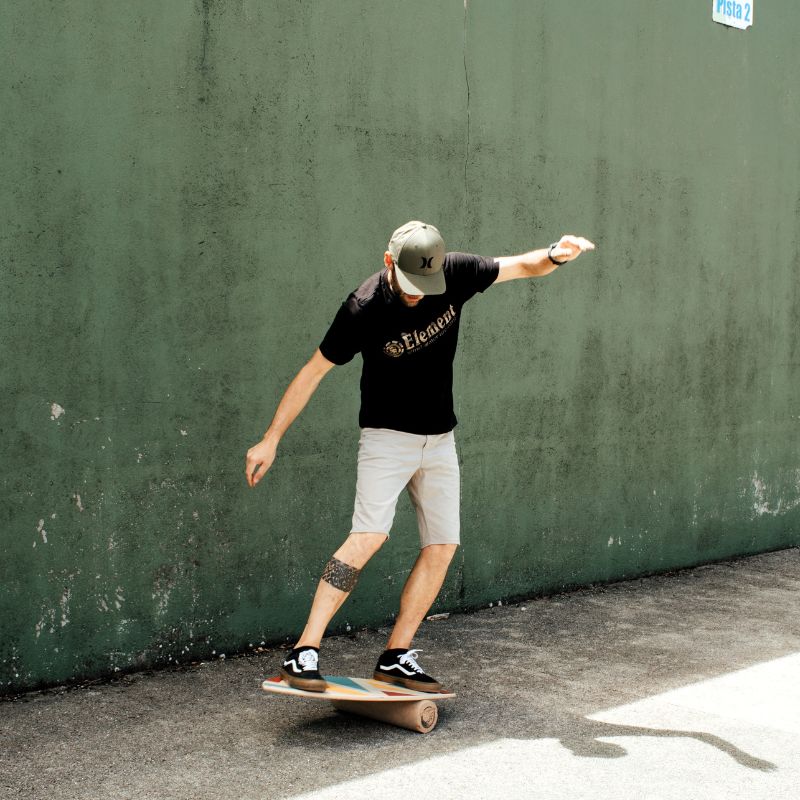

Exercises to strengthen legs and improve balance with Balance Boards
Your legs are the foundation of your body, and their strength is key to any physical activity: from sports like cycling, surfing, or running to everyday tasks such as walking, climbing stairs, or standing for hours.
Training on an unstable surface, such as a Balance Board, adds an extra benefit: while you work on leg strength, you also improve your balance, coordination, and proprioception (your body's ability to “feel” the position of your joints). Various studies have shown that this type of training helps improve stability and lower-body strength and can help reduce the risk of ankle sprains when incorporated regularly into your routine.
In this article, you'll find a series of exercises designed to strengthen your legs and improve your balance using a Balance Board. You can adapt them to your level, whether you're just starting out or already have experience.
Before you start: safety and warm-up
Before getting on the board, keep the following in mind:
-
Warm up for 5–10 minutes: ankle, knee, and hip mobility; some gentle squats; some marching in place.
-
Safe environment: do the exercises away from furniture, edges, or corners. If you're just starting out, you can stand near a wall or stable chair to hold on if needed.
-
Gradual progression: start with slow, controlled movements. When you feel confident, add intensity, time, or variations.
-
If you have a history of knee, ankle, or back injuries, consult a healthcare or exercise professional before trying advanced variations.
Exercise 1: Deep squats
Stand on the Balance Board with your feet shoulder-width apart. Engage your core (by pulling your belly button slightly inward) and keep your gaze forward.
From there, perform slow, controlled squats, lowering your hips back and down until your thighs are parallel to the floor or as far as your mobility allows.
Push off the floor with your feet to return to the starting position, maintaining your balance throughout the movement.
Benefits:
-
Strengthens the quadriceps, hamstrings, and glutes.
-
Works dynamic balance and knee and ankle stability.
Workout recommendation:
-
2–3 sets of 8–12 repetitions, resting 45–60 seconds between sets.
Variations:
-
Hold light weights or a dumbbell to add resistance.
-
Hold pauses of 2–3 seconds at the lowest point to intensify the work.
-
For an advanced level, try performing the squat more slowly on the lowering phase (3–4 seconds).
Exercise 2: Alternating lunges
Stand on the Balance Board with one foot in the center. From there, step forward with the other leg, as if performing a classic lunge, keeping your torso upright.
Control your balance as you bend both knees, then slowly return to the starting position. Alternate legs.
Benefits:
-
Strengthens the legs unilaterally, helping to correct strength differences between the right and left sides.
-
Develops balance by working single-leg support in a more demanding way.
Workout recommendation:
-
2–3 sets of 6–10 repetitions per leg.
Variations:
-
Increase the lunge depth for greater intensity.
-
Hold the front foot elevated for 2–3 seconds before returning to work balance more.
-
For a greater challenge, hold a light weight or kettlebell close to your body.
Exercise 3: Balance deadlift
Stand on the Balance Board with your feet hip-width apart.
With a straight back and a slight bend in your knees, lean your torso forward, bringing your hands toward your knees, shins, or ankles (depending on your mobility). Feel your hamstrings stretch without rounding your lower back.
Slowly return to the starting position, contracting your glutes and maintaining your balance throughout the movement.
Benefits:
-
Strengthens the hamstrings, glutes, and lower back muscles.
-
Improves posture and hip stability.
Workout recommendation:
-
2–3 sets of 8–10 repetitions.
Variations:
-
Use a light dumbbell or kettlebell to intensify the exercise.
-
Perform the exercise with one leg on the Balance Board, leaving the other leg extended slightly behind (single-leg deadlift).
-
To progress, try reducing the support of your hands on your body, relying more on postural control.
Exercise 4: Calf raises
Stand on the Balance Board with your feet together or hip-width apart.
From there, slowly raise your heels until you are on your tiptoes, maintaining your balance. Lower in a controlled manner until your entire foot is flat on the floor again.
Benefits:
-
Strengthens the muscles of the calves (gastrocnemius and soleus).
-
Improves ankle stability and fine foot coordination.
Workout recommendation:
-
2–4 sets of 12–15 repetitions.
Variations:
-
Perform the exercise with one foot to increase the difficulty.
-
Add a small faster push-off when going up and lower slowly to work power and control.
-
Hold the tiptoe position for 3–5 seconds before lowering for more isometric work.
Exercise 5: Controlled jumps
Stand on the Balance Board.
Perform small jumps vertically, barely lifting your feet off the board, and focus on landing softly, absorbing the impact with your knees and maintaining your balance after each jump.
Important: this exercise is for an intermediate/advanced level. If you're just starting out or have a history of knee or ankle injuries, prioritize low-impact exercises first.
Benefits:
-
Improves leg power and coordination.
-
Increases reaction time and dynamic stability during rapid changes.
Workout recommendation:
-
2–3 blocks of 15–20 seconds of jumping, with 40–60 seconds of rest.
Variations:
-
Perform lateral jumps (from one side of the board to the other) to work stability in different directions.
-
For advanced users, try wider jumps, but always in a very safe environment and without rushing.
-
Only for people with very good control: perform the exercise with your eyes half-closed or in low light (this reduces visual cues and increases the proprioceptive challenge).
Exercise 6: Lateral step with balance
Stand next to the Balance Board.
Take a lateral step to place one foot on the board, then step up with the other foot in a controlled manner. Maintain your balance on the board for a few seconds, then step down, starting with the same leg you stepped up with. Repeat on both sides.
Benefits:
-
Strengthens the lateral muscles of the legs and hips (abductors, gluteus medius).
-
Improves lateral stability, which is key for changes of direction, surfing, skating, or contact sports.
Workout recommendation:
-
2–3 sets of 8–10 repetitions per side.
Variations:
-
Increase the speed of going up and down to also work cardiovascular endurance.
-
Maintain a low position, similar to a semi-squat, while performing the lateral steps to intensify the effort.
-
Hold a resistance band between your hands, pulling gently to also engage the core and shoulders.
Exercise 7: Glute bridge with Balance Board support
Place the Balance Board on a stable surface. Lie on your back on the floor and place the upper part of your back on the board, with your feet flat on the floor and your knees bent.
From there, raise your pelvis until your body forms a straight line from your shoulders to your knees. Hold for 1–2 seconds at the top and lower slowly.
Benefits:
-
Strengthens the glutes, hamstrings, and lower back.
-
Engages the core by adding the balance component of the board.
Workout recommendation:
-
2–3 sets of 10–12 repetitions.
Variations:
-
Perform the exercise with one leg raised, supporting yourself with only one foot on the floor for a greater challenge.
-
Place a resistance band around your knees and push them slightly outward to engage your outer glutes more.
-
Increase your time under tension (3–4 seconds) for each repetition.
How to incorporate these exercises into your routine
To get the most out of them without overtraining, you can follow these general guidelines:
-
Frequency: 2–3 days per week.
-
Duration: between 20 and 30 minutes per session.
-
Suggested structure:
-
Warm-up (5–10 minutes).
-
4–5 exercises from the list (for example: 1, 2, 3, 4, and 7).
-
2–3 sets per exercise, with the suggested number of repetitions.
-
Gentle stretching at the end.
-
If you participate in other sports (surfing, skateboarding, mountain biking, running, etc.), you can schedule these routines on complementary training days or after a light session.
Conclusion: stronger legs and better balance with every session
These Balance Board routines are ideal for strengthening your legs while improving your balance, coordination, and body control.
The key is consistency: by practicing for a few minutes several times a week, you will gradually notice that your footing becomes steadier, your stability improves, and you feel more confident in both your daily life and your sport.
Practicing these exercises regularly can help you:
-
strengthen your leg and glute muscles,
-
improve your stability and proprioception,
-
and reduce the risk of sprains and strains, especially in the ankle, when combined with proper technique and progression.
Dare to incorporate these movements into your training and discover the benefits of a more dynamic and functional workout with your Balance Board.